By Noël Durman
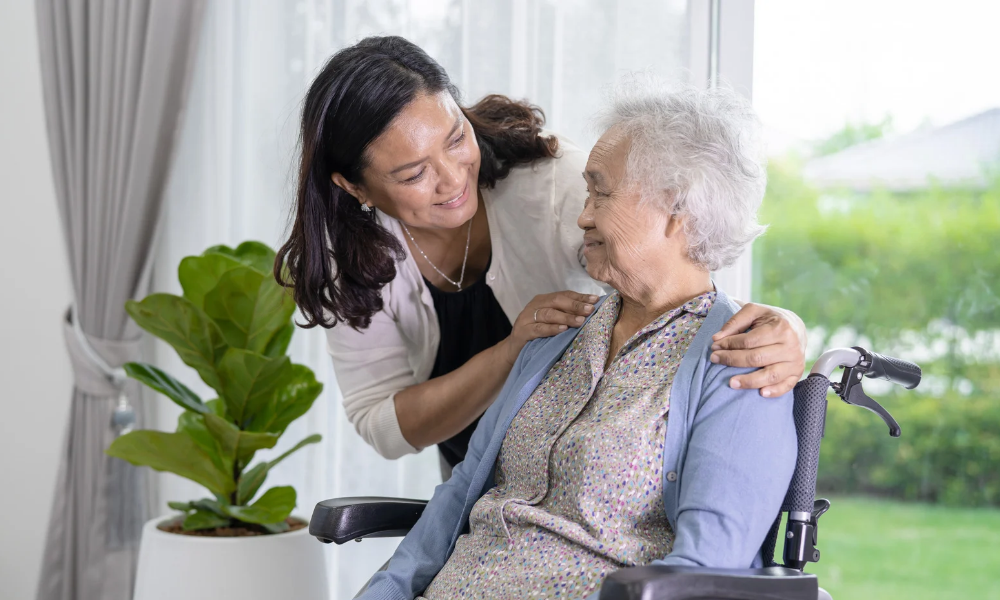
Every Wednesday morning, Jane Euler greets Beverly with a hug and takes her usual seat at the end of the couch, turned so the two women can look straight at each other. Most weeks, soon after she sits down, a cardinal lands on the birdfeeder attached to Beverly’s window. They catch each other’s eye and say it together: “That’s Gene!”
Gene was Beverly’s husband. He died in 2012, and Beverly believes he still checks on her. She has plenty of company in that belief: for many people, a cardinal at the window means someone loved and lost is still near. Jane shares Beverly’s belief. “It’s so special,” she said.
Beverly is facing the end of her life. She is a Goodwin Hospice patient, and Jane is her end-of-life doula, a trained, non-medical companion for people in hospice care. Their Wednesday hour together has become a fixture of Beverly’s week.
How a Goodwin Hospice Patient Met Her End-of-Life Doula
Beverly is always well-dressed, with long white hair she twirls into a curl while she talks. She calls herself an “emoter.” She likes to talk and to think things through, and she questions everything. For much of her working life she was a pastoral counselor, the person others turned to in their hardest times. “I can see that in her,” Jane said. “She is extremely thoughtful.”
The two met because of Liz Paquette, a registered nurse with Goodwin Hospice and a member of Beverly’s hospice care team. Liz thought Beverly and Jane would like each other, and that Jane could be another support for her.
She was right. Beverly had come to Goodwin Hospice with a life-limiting illness, and the illness was only part of what she carried. She was grieving Gene, the farm that had been home to her, her pets and the life she left behind when she moved into assisted living. What she needed was room for all of it, and a person to explore it with. That is what Wednesday mornings with Jane became for her.
What Does an End-of-Life Doula Talk About With Patients?
Jane starts each visit asking how the week has been, and Beverly usually has topics ready, so they dive right in. Her spirituality comes up often. So do her questions about dying, and she and Jane spend much of the hour working through them.
Beverly is willing to say out loud what so many people quietly wonder. “Is it normal to feel that way?” she often asks, and Jane appreciates the openness and curiosity behind her questions.
“I can share my concerns, my doubts, my worries and my fears about the death process with my doula, who assists me in finding my own solutions to unanswered questions and concerns,” Beverly said.
Jane listens, shares what she knows and helps her think things through. Any decisions are Beverly’s to make.
Jane also brought Beverly an idea from Dr. Ira Byock’s book, “The Four Things That Matter Most;” that what people most need to say to one another at the end of life comes down to four short statements: I forgive you. Please forgive me. Thank you. I love you.
Beverly is having this conversation with each of her four children. It is deliberate work, not always easy, and she’s taking it on by choice.
Beverly’s children and grandchildren are at the center of nearly everything she does. Her main priority, Jane said, is making sure her children are never left holding decisions about her arrangements. Beverly is settling those questions now, herself, so they won’t have to.
How End-of-Life Doulas Support Hospice Patients and Families
Dying is something we only do once. It can be challenging to face what is happening to you and, at the same time, how it’s impacting those you love. In hospice, it is often said that a family’s greatest worry is that the person they love will be in pain, while the dying person’s greatest worry is whether their family will be ok without them. Nurses, aides, chaplains, social workers and doulas like Jane have walked alongside many patients and families through the end of life, and that experience can make an unfamiliar time feel a little less overwhelming.
A doula’s part in it is entirely non-medical. Jane co-founded Present for You, the end-of-life doula practice Goodwin Hospice contracts with to provide this special service to patients, and she is direct about the boundaries: doulas don’t provide medical care or advice, don’t make clinical decisions and don’t offer legal or financial guidance. “Doulas work alongside care teams, not instead of them,” she shared. “Our role is to support the human experience.”
What a doula brings to hospice care is extra presence. Jane may spend more time with a patient, and visit more often, than other members of the care team are able to. That makes her another set of eyes and ears. Jane knows Beverly doesn’t want to be in pain, so if she notices Beverly showing signs of discomfort, she lets her nurses and hospice team know.
Doulas also help with practical matters. They can explain documents such as advance directives, help families stay organized and informed, support difficult conversations and make phone calls or tackle paperwork that can feel overwhelming. Taking some of those tasks off a family’s plate leaves more time and energy for simply being together with their loved one.
Jane sees the doula’s role as following the patient’s lead. There is no set menu of services. Every patient wants different things, so Jane meets them where they are and supports what matters most to them.
Beverly describes the role more simply: “My end-of-life doula is a listener, a guide, an informer, a helper and, of course, a friend.”
Jane was doing this work long before she knew it had a name. She spent 32 years in information technology, and along the way kept finding herself walking with people through the end of life—a neighbor here, a church friend there. When she read an article about end-of-life doulas, she felt called to learn more. She took two training courses, earned a master’s degree in palliative care and co-founded Present for You. In partnership with Goodwin Hospice, the practice has provided more than 2,000 visits in just over two years.
“Every patient at Goodwin Hospice is surrounded by an excellent care team,” said Tammy Suggs, Executive Director of Home Health & Hospice at Goodwin Living. “An end-of-life doula adds an extra layer of support. It eases some of the load on our team members, and it helps us deliver on our mission of patient-centered care. Most hospices can’t offer that at no cost to patients, and when a patient or family wants a doula, we want to be able to say yes. Thanks to the generosity of donors to the Goodwin Living Foundation, we can.”
Jane will tell you she gets as much from the visits as she gives. “I have learned so much from Beverly,” she says. “I’ve seen how much thought she’s putting into making things easier for her family. That stays with me.”
The Wednesday visits continue. Beverly keeps her topics ready, and the cardinal keeps coming to the window.
How Donor Support Makes End-of-Life Doula Care Possible
Goodwin Hospice is one of only two remaining nonprofit hospices in Northern Virginia. That means it can offer patients and families care that insurance won’t cover.
End-of-life doula visits are one example. Medicare and private insurance don’t pay for them, so Goodwin Hospice provides them through gifts to the Hospice Fund, which also supports therapeutic massage and hospice care for patients without insurance.
To learn more or to give, contact Noël Durman, Director of Hospice Giving, at 703-824-1369 or ndurman@goodwinliving.org.
______________
Noël Durman is Director of Hospice Giving at the Goodwin Living Foundation, where she works to connect donors with the meaningful care Goodwin Hospice provides every day. She brings more than 20 years of nonprofit fundraising experience spanning international conservation, conflict resolution and services for older adults.