
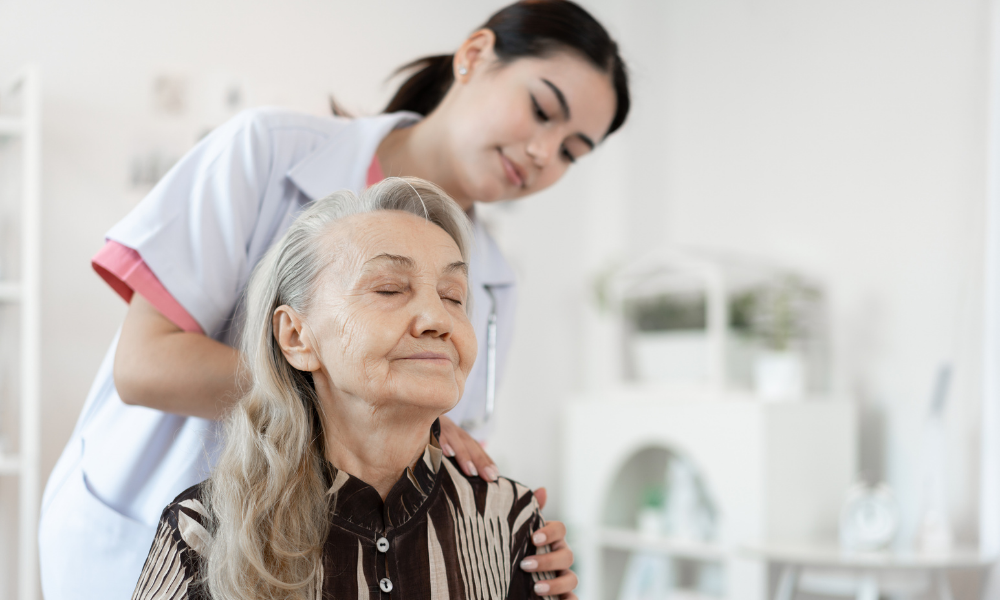
How therapeutic massage brings comfort, attention, and relief to patients and caregivers in hospice care.
By Noël Durman
Once a week, Healwell massage therapist Cindy pulls a chair beside John’s wheelchair.
John has Alzheimer’s and no longer speaks. He has received therapeutic massages from Cindy for nearly two years, and he recognizes her. As she settles in and begins her work, he leans into her hands. His shoulders drop. Sometimes he smiles, and sometimes he even reaches out just to hold her hand.
When John first began receiving care from Goodwin Hospice, his wife, Linda, didn’t know much about hospice. She chose Goodwin Hospice because someone she trusted recommended it. When John’s hospice nurse suggested therapeutic massage, Goodwin Hospice covered the first three sessions as part of the individualized care it offers patients and families.
Linda saw what those visits gave John: relaxation, recognition and a steady connection with Cindy.
“It’s one-on-one attention, focused just on him,” Linda said. “That’s so important.”
She now recommends both Goodwin Hospice and therapeutic massage to other families, just as someone once recommended them to her.
Therapeutic Massage Offers More Than Comfort
Therapeutic massage may sound like an added comfort, something soothing but separate from medical care. People often hear “massage” and picture a spa, but at the end of life it becomes a very different kind of care.
“This is clinical work,” says Laura Bryant Earner, Service Director at Healwell, the nonprofit organization that partners with Goodwin Hospice to provide therapeutic massage to hospice patients and their loved ones. “We’re working with people experiencing illness, fatigue, discomfort and perhaps loneliness. The goal isn’t relaxation in a spa sense; it’s comfort that responds to what the patient is experiencing in that moment. Alongside everything the hospice team is already doing, Healwell therapists are helping relieve pain, insomnia, nausea, anxiety and general discomfort.”
Regine understands the difference firsthand. Her husband, Jaime, is in the last phase of Alzheimer’s. He is moved between a wheelchair and a bed, and his body can grow very stiff. When his Goodwin Hospice nurse suggested therapeutic massage, Regine thought, “here is something I can still do for him.” What surprised her was how gentle it turned out to be.
“I had in mind how it is when I get a massage,” Regine said. “The soft touch his therapist, Angela, used really surprised me. The massage I’d been thinking of would have been way too intense. It would make him nervous.”
For someone like Jaime, whose needs have changed with the progression of Alzheimer’s disease, that kind of adjustment matters. Hospice massage therapists adjust their pressure, positioning and pace for people who may be frail, in pain or not able to communicate well. Angela worked slowly and quietly, adapting her approach at each session with Jamie.
“Angela is wonderful,” Regine said. “She takes her time and has so much patience. I admire that.”
“Our therapists train specifically for this,” Laura said. “It takes clinical skill and experience to safely care for patients at the end of life.”
Called to Work in Hospice Therapeutic Massage
Cindy came to hospice massage through her own experience caring for people with cancer, as well as her mother.
After many years working in healthcare, she trained as a massage therapist because she kept seeing how much comfort touch could bring to people living with serious illness. Later, she also trained as an end-of-life doula, which shapes the characteristics she brings to her work: steadiness, attentiveness and empathy.
“I learned through my work experience and caring for my mother at her end of life that my passion is to give during that sacred time,” she said.
In eight years of practicing hospice massage, there’s one phrase she has heard many times that still stops her: “I haven’t had human touch in so long.”
She heard it again just last week.
When someone is seriously ill, the people around them can sometimes be a bit hesitant to touch them, afraid of causing pain or unsure what’s safe. Even someone surrounded by care and love may receive less everyday touch than they once did. Therapeutic massage offers safe, intentional touch at a time when many people are receiving less of it, especially those who don’t have loved ones nearby. “I remember my grandma smoothing back my hair,” Cindy said. It’s the kind of touch she tries to give now.
An Hour That Belongs to the Patient
Ask Linda what matters most about the massage for her husband, and she does not start with John’s muscles. She starts with the focused attention.
Hospice nurses, aides and facility caregivers provide steady care throughout the week. Therapeutic massage adds something different: an hour centered entirely on one person’s comfort, pace and response.
Regine sees it the same way. Jaime receives great care where he lives, but the caregivers there look after many people at once. An hour with someone focused solely on him is its own kind of gift.
Caring for Caregivers, Too
The impact of massage can reach the caregiver as well. Goodwin Hospice covers three sessions for each patient and family, and families decide together how to use them. Some devote every session to the patient; others share the time so the caregiver can receive support too.
For Regine, the massage matters most as something she can still do for Jaime, a way to keep giving to him during such an important time.
“It gives me great comfort that I’m still able to provide some comfort for my husband at the end of his life,” she said.
Other caregivers accept the time for themselves, though many need convincing. The strain of caregiving can settle into the neck and shoulders before people notice it, and Cindy says many wave off the idea that any of the time should go to them.
“They’ll tell me, ‘No, no, you’re not here for me,'” she said. She smiles and answers, “Just give me ten or fifteen minutes.”
Afterward, she often hears the same thing: “I didn’t realize I was holding so much tension. I feel so much better.”
Care that Fits the Person
“Our first question is always what the person in front of us needs,” says Tammy Suggs, Executive Director of Goodwin Hospice. “Therapeutic massage is one of the ways we support patients, and it fits beautifully alongside the care our hospice team is already providing. We’re always looking at the person in front of us as an individual, not a diagnosis, and trying to understand what will make a real difference in their comfort and experience.”
For Linda, the impact is clear: “It gives him that physical touch that is so important,” she said.
And for Regine, the comfort runs both ways.
“While it brings comfort to my husband,” she said, “it also brings a great deal of comfort to me to be able to get him this care. It’s important to support the caregivers. There’s a lot of stress, both emotional and financial.”
Offering complimentary therapeutic massage is another way Goodwin Hospice reaches beyond illness to care for the person at the end of life and the people who love them.
Comfort Care, Made Possible by Donors
Goodwin Hospice is one of the few nonprofit hospices in our area. That means we can offer patients and families additional care that insurance won’t cover.
Therapeutic massage is one example of the support donor generosity makes possible. Medicare and private insurance don’t pay for it, so Goodwin Hospice provides three complimentary sessions to each patient and family through donor support. For someone at the end of life, this skilled touch can ease pain, calm anxiety and bring comfort that medicine alone can’t.
Gifts to the Goodwin Living Foundation Hospice Fund keep this care available for families across our community.
To learn more or to give in support of this fund, contact Noël Durman, Director of Hospice Giving, at 703-824-1369 or ndurman@goodwinliving.org.
______________
Noël Durman is Director of Hospice Giving at the Goodwin Living Foundation, where she works to connect donors with the meaningful care Goodwin Hospice provides every day. She brings more than 20 years of nonprofit fundraising experience spanning international conservation, conflict resolution and services for older adults.