By Kathie Miller
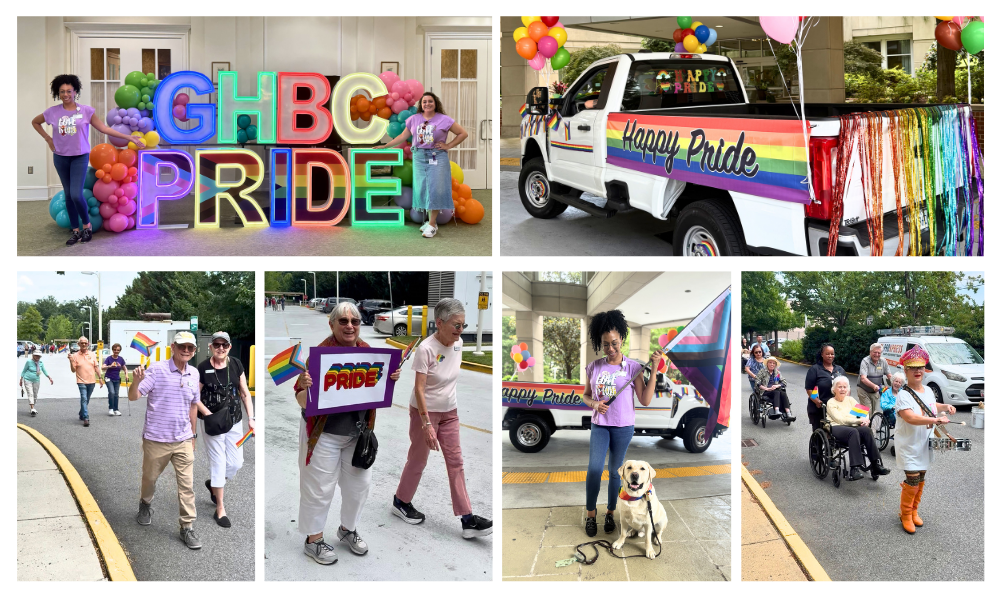
June is LGBTQ+ Pride Month. Every summer, people come together throughout the month to celebrate diversity, acceptance and the important contributions LGBTQ+ people make to society, both in the United States and around the globe. And every summer, Goodwin Living celebrates Pride throughout the month at our Senior Living Campuses, bringing residents and team members together to honor the occasion.
While the events today (both at Goodwin Living and around the world) commonly feature festive and joyous gatherings and parades, it’s important for us to remember the history behind it.
The Night that United a Movement
We celebrate Pride Month every June due to a pivotal event that happened in the summer of 1969. The Stonewall Uprising started in the early morning of June 28, when police officers raided the Stonewall Inn, a popular gar bar in New York City.
Raids like this were common at the time. Gay rights did not yet exist. Being open came with risks. LGBTQ+ individuals could lose their jobs and get evicted from their homes. They were viewed by many as being “mentally ill” and treated with open disdain and disrespect. The police frequently raided the Stonewall, but on this night, patrons and staff resisted and the situation quickly became a riot.
Immediately following this momentous raid, a series of protests took place over the course of several days. Prior to Stonewall, gay rights activists had chosen to hold vigils and silent walks in their attempts to affect change. After this series of protests in the summer of 1968, they realized it was time to switch tactics.
The First Pride Parade Was a Protest
Five months after the Stonewall Uprising, activists gathered in Philadelphia for an annual conference of LGBTQ+ organizations. They agreed to start an annual march to mark the anniversary of Stonewall, and on June 28, 1970, the Christopher Street Gay Liberation Day March was held, with help from protest organizer Brenda Howard, recognized today as the “Mother of Pride”.
While organizing the march, activists decided they wanted people from outside New York City to participate, and they needed a theme to draw them in. In a 2015 interview with the podcast The Allusionist, a key organizer Craig Schoonmaker shared, “First thought was ‘Gay Power’. I didn’t like that, so I proposed Gay Pride.”
Schoonmaker continued, “There’s very little chance for people in the world to have power. People did not have power then; even now, we only have some. But anyone can have pride in themselves, and that would make them happier as people, and produce the movement likely to produce change.”
The official chant for that first march in 1970 was “Say it loud, gay and proud.”
More than 50 Years of Pride
New York was not the only city to host protests in 1970 to mark the anniversary of Stonewall. Thousands gathered in other U.S. cities, including Boston, Chicago, Los Angeles and San Francisco. And throughout the country, organizers did not limit themselves to just a single march on a designated day.
Since 1969, progress has been made in support of LGBTQ+ rights. With this progress, protests turned into parades and picnics and speaking events, all geared towards celebrating LGBTQ+ culture and supporting equal rights. In 1999, President Bill Clinton became the first U.S. President to recognize June as Pride Month by issuing a proclamation.
Typically, Pride Month activities occur throughout the month and culminate in a parade on the last weekend of June, both across the U.S. and around the globe.
Understanding the Rainbow Flag, the Symbol of Pride
You are probably familiar with the rainbow flag as the symbol of pride. But it was not the first symbol. As the pride movement gained momentum, the pink triangle became a symbol of the cause, but it had a dark history. In Nazi Germany, the downward facing pink triangle identified gay men in concentration camps.
With its complicated history, the pink triangle left some activists wanting something different. One of those activists was artist Gilbert Baker. In his memoir Rainbow Warrior, Baker wrote “We all felt that we needed something that was positive, that celebrated our love.”
Having seen how the power of American flag during the 1976 Bicentennial of the United States, Baker realized the potential power a flag could have to unify people. And in 1978, he came up with the idea of using the rainbow.
Baker continued, “A Rainbow Flag was a conscious choice, natural and necessary. The rainbow came from earliest recorded history as a symbol of hope. In the Book of Genesis, it appeared as proof of a covenant between God and all living creatures. It was also found in Chinese, Egyptian and Native American history. A Rainbow Flag would be our modern alternative to the pink triangle. Now the rioters who claimed their freedom at the Stonewall Bar in 1969 would have their own symbol of liberation.”
As with all things, the rainbow flag has evolved over time. The original flag had eight colors, and each color was assigned a meaning:
- Hot pink meant sex
- Red meant life
- Orange meant healing
- Yellow meant sunlight
- Green meant nature
- Turquoise meant magic/art
- Indigo meant serenity
- Purple meant spirit
Goodwin Living Commitments
At Goodwin Living, we commit ourselves to values that support our mission. Two key values are community and individuality. Here’s how we define them:
- Community: We seek to create and sustain strong and caring communities where those who live, work and visit will find places of welcome and belonging.
- Individuality: We believe that each person is of sacred worth. We celebrate the uniqueness and diversity of the members of our community.
As we express these values both in our workplace and in how we care for and serve older adults, we seek guidance and training from third-party resources. Recognizing the need to raise awareness and understanding of LGBTQ+ aging issues, we sought SAGECare certification.
“Residents first brought the SAGECare certification to our attention,” shared Chief People Officer Fran Casey. “We knew we wanted to educate people, so we embarked on a training program with SAGECare that we could incorporate into both our onboarding and ongoing training programs. Our program is very intentional and ongoing—it’s part of our organizational culture.”
Since Goodwin Living first became SAGECare certified in 2020, we have maintained our certification and increased it from Gold to Platinum status. To achieve Platinum-level status, 80% of management must complete the management course and 80% of staff must complete a one-hour SAGECare course. SAGECare training has been integrated into to our on-boarding education for new employees, and team members must take refresher courses as part of annual training as well.
Goodwin Living remains committed to celebrating our LGBTQ+ community and every individual member of it for everything they bring to making our lives better.
———————————-
As Corporate Director of Marketing & Communications, Kathie Miller provides strategic guidance and tactical support for all areas of Goodwin Living. She writes, edits and manages The Good Life blog and newsletter. Kathie joined GHI in 2014 after nearly 15 years at NPR, where she honed her skills in brand and reputation management, content marketing and internal communications. Originally from Pennsylvania, Kathie has slowly come to realize she’s lived in Arlington for more than half her life and should call herself a Virginian. She enjoys the outdoors and brings her rescue dog, Remi, to work every day.