
by Amanda Ranowsky and Sparkle Lawson
Editor’s Note: Originally written and published in 2020, this article has now been updated with new content and context.
For Goodwin Living President & CEO Rob Liebreich, the fight against dementia is personal.
In 2011, Rob and his family noticed that his mother, Wendy, started repeating herself and forgetting recent conversations. She was finding it challenging to focus, losing her math skills and would lose her way while driving. Wendy was showing signs of what experts call “mild cognitive impairment.”
According to the Mayo Clinic, mild cognitive impairment (MCI) is defined as “the stage between the expected cognitive decline of normal aging and the more serious decline of dementia.” The Alzheimer’s Association reports that approximately 12% to 18% of people aged 60 or older are living with MCI, and that one-third of people living with MCI due to Alzheimer’s disease develop dementia within five years.
Working in the field of senior living and healthcare, Rob hoped he’d have an easier time finding ways to treat MCI. His search yielded the same results many encounter when they or a loved one receive such a diagnosis—no answer and no prescription for recovery. MCI has no standard treatment whatsoever. Those who suffer from it are generally advised to make efforts to stay healthy and to hope for the best.
For those who progress into dementia or Alzheimer’s, some symptoms—namely confusion, and loss of memory and thinking skills—can temporarily improve or stabilize with certain drugs, but pharmaceutical options are not helpful for all patients. While researchers around the globe continue to search for a cure, currently there are no drugs that can stop the progression of dementia or Alzheimer’s.
“I want to do everything I can not to lose you,” Wendy said to the family. Now they just had to find a solution.
A Hope for Help
While taking part in a LeadingAge conference for non-profit senior living organizations, Rob attended a session that would change his and Wendy’s lives. The session reported on a program used by individuals with advanced dementia. The program included simple activities that triggered greater brain activity in the prefrontal cortex. Research has shown that engaging the prefrontal cortex can help us stabilize and even improve cognitive function as we age.
“At the time, my mom was showing signs of some mild cognitive decline,” Rob explained. “Though she was still able to function independently in her daily tasks, she was repeating herself and not remembering everything.” Rob wondered what might happen if someone with mild cognitive changes started engaging regularly in simple activities that engage the prefrontal cortex.
“I asked my mom to take a leap of faith with me,” Rob continued. “I asked her to commit to engaging in simple mental exercises that involved basic math, reading and writing for a minimum of 30 minutes each day. The goal was to enhance recall and processing, which is associated with the prefrontal cortex of the brain.”
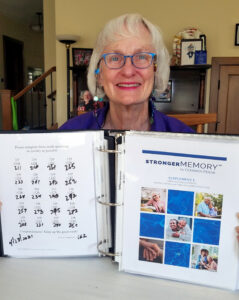
Wendy, enrolled in simple math courses and began practicing writing and reading out loud every day. Within a month, Wendy and her family could tell her symptoms had lessened. She wasn’t repeating herself nearly as often, and her memory sharpened. After three months, her math skills improved, along with her ability to focus. She has continued her commitment to daily mental exercises. In the years since she began this steady practice, Wendy picked up new skills, like learning to play Mahjong, birding and playing better Bridge.
Seeing the incredible effects these simple exercises had on his mom, Rob wanted to develop a program that could be used by others facing similar challenges. He called this program StrongerMemory.
The StrongerMemory Program Takes Off
The first StrongerMemory pilot program launched in 2021 as small groups of residents at Goodwin House Alexandria (GHA) and Goodwin House Bailey’s Crossroads (GHBC) gathered to work on brain health exercises together. Rob and the Goodwin Brain Health team developed a workbook of math problems and writing prompts that people can use to engage with the program. Thanks to the generosity of donors to the Goodwin Living Foundation, they were able to make the workbook publicly available to download at no cost and offer a printed copy for a nominal fee.
Later in 2021, Goodwin Living began a partnership with George Mason University to study the effectiveness of the StrongerMemory program. Initial results showed that the StrongerMemory program helped people with MCI, and that participants on average reported their memory as being better after completing the StrongerMemory program.
Through grant funding provided by Secretary of Aging Rona Kramer and collaboration with Maryland Department of Aging (MDOA) team members Cameron Pollock and Latanya Clark, seven Maryland counties launched StrongerMemory programs starting in April 2022.
A Grant Strengthens the StrongerMemory Initiative
In October 2022, StrongerMemory received a grant from the Centers for Medicare & Medicaid Services Civil Money Penalty Reinvestment Program (CMP) to implement the program in skilled nursing communities across the Commonwealth of Virginia at no cost to the residents or campuses.
This grant had widespread impact:
- 91 nursing facilities implemented StrongerMemory
- 862 residents participated in the program
- 76% of participants maintained or improved their cognitive functioning
- More than half of the facilities committed to continuing StrongerMemory after the initial 12-week sessions.
StrongerMemory in Action: Moments from Across the Commonwealth
Across Virginia, communities have embraced StrongerMemory in monumental ways. At Covenant Woods in Mechanicsville, residents enjoyed the program so much it made the news, proving that community-driven experiences can create headlines. Residents at The Virginia Home in Richmond didn’t just do StrongerMemory—they formed a group called “The Brainiacs” to keep each other accountable, turning the program into a shared mission. At Tate Springs in Lynchburg, StrongerMemory became so popular that team members moved the sessions to the afternoon so more residents could participate, “because the party is just getting started then!”
One participant at King’s Grant in Martinsville was hesitant to leave her room before starting the program. Now, she attends every session with her husband by her side. At Amelia Rehab & Healthcare Center in Amelia Courthouse, residents took StrongerMemory to the next level by reading a novel aloud as a group, then hosting a movie screening of the adaptation complete with a red-carpet celebration for participants and their families.
These are just a few examples of the impact StrongerMemory has had on participating older adults. Simple, daily exercises can lead to meaningful connections, renewed confidence and improved cognitive well-being.
Spreading Hope
When he first conceived of the program, and with his mother’s experience at the front of his mind, Rob envisioned StrongerMemory helping many people slow the symptoms of cognitive decline. Today, StrongerMemory has touched the lives of 60,000 older adults across 44 states and three countries. And in November 2025, Goodwin Living and researchers from George Mason University announced new findings that prove the effectiveness of StrongerMemory.
Rob feels that the success of StrongerMemory brings much-needed hope. “When people have a diagnosis of brain health issues or cognitive decline, there’s very little hope in that diagnosis,” he said. “What we’ve experienced with StrongerMemory, talking with caregivers and talking with people who are going through brain health decline themselves, is that for the first time, they feel like they can do something. They have some control in the matter. And by doing this program, they might have a chance for better outcomes.”
Watch this video to see Wendy Liebreich share her tips for doing the StrongerMemory exercises.
You can download our StrongerMemory Workbook or purchase a printed copy at this page.
Questions, feedback, or want to get involved? Contact us at StrongerMemory@goodwinliving.org.
————————————-
As Marketing & Communications Specialist, Amanda Ranowsky partners with colleagues throughout Goodwin Living to tell our stories and raise brand awareness. From printed collateral to digital marketing, Amanda covers many bases. Before joining Goodwin Living, Amanda worked for a small, family-owned business where she gained experience in content marketing. Amanda’s creative expression extends beyond the office. She is an active member of community theater and chorus groups.
As a Marketing & Communications intern, Sparkle Lawson collaborates with team members to help share the Goodwin Living mission. From writing blogs to capturing photo and video content at events, Sparkle aims to craft compelling stories that highlight the vibrant community and impactful work that shapes Goodwin Living. Before joining Goodwin Living, Sparkle interned at several entertainment, beauty and fashion companies where she gained experience in content and event marketing.